> ## Documentation Index
> Fetch the complete documentation index at: https://docs.flashcat.cloud/llms.txt
> Use this file to discover all available pages before exploring further.
# Influxdata
Sync Influxdata alert events to Flashduty via webhook to achieve automated alert noise reduction.
## In Flashduty
***
You can obtain an integration push URL through either of these two methods:
### Using Private Integration
Choose this simpler option when you don't need to route alert events to different channels.
Expand
1. Go to the Flashduty console, select **Channel**, and enter a channel's details page
2. Select the **Integrations** tab, click **Add Integration** to enter the integration page
3. Choose **Influxdata** integration, click **Save** to generate a card
4. Click the generated card to view the **push URL**, copy it for later use, and you're done
### Using Shared Integration
Choose this option when you need to route alerts to different channels based on the alert event payload.
Expand
1. Go to the Flashduty console, select **Integration Center=>Alert Events** to enter the integration selection page
2. Select **Influxdata** integration:
* **Integration Name**: Define a name for this integration
3. Configure the default route and select the corresponding channel (after the integration is created, you can go to `Route` to configure more routing rules)
4. Click **Save** and copy the newly generated **push URL** for later use
5. Done
## In Influxdata
***
Supports Influxdata versions 1.x \~ 2.x, with different configurations for each version as detailed below.
* [Version 2.x](#v2)
* [Version 1.x](#v1)
## I. Influxdata Configuration
### Version 2.x
#### Step 1: Create Alert Channel
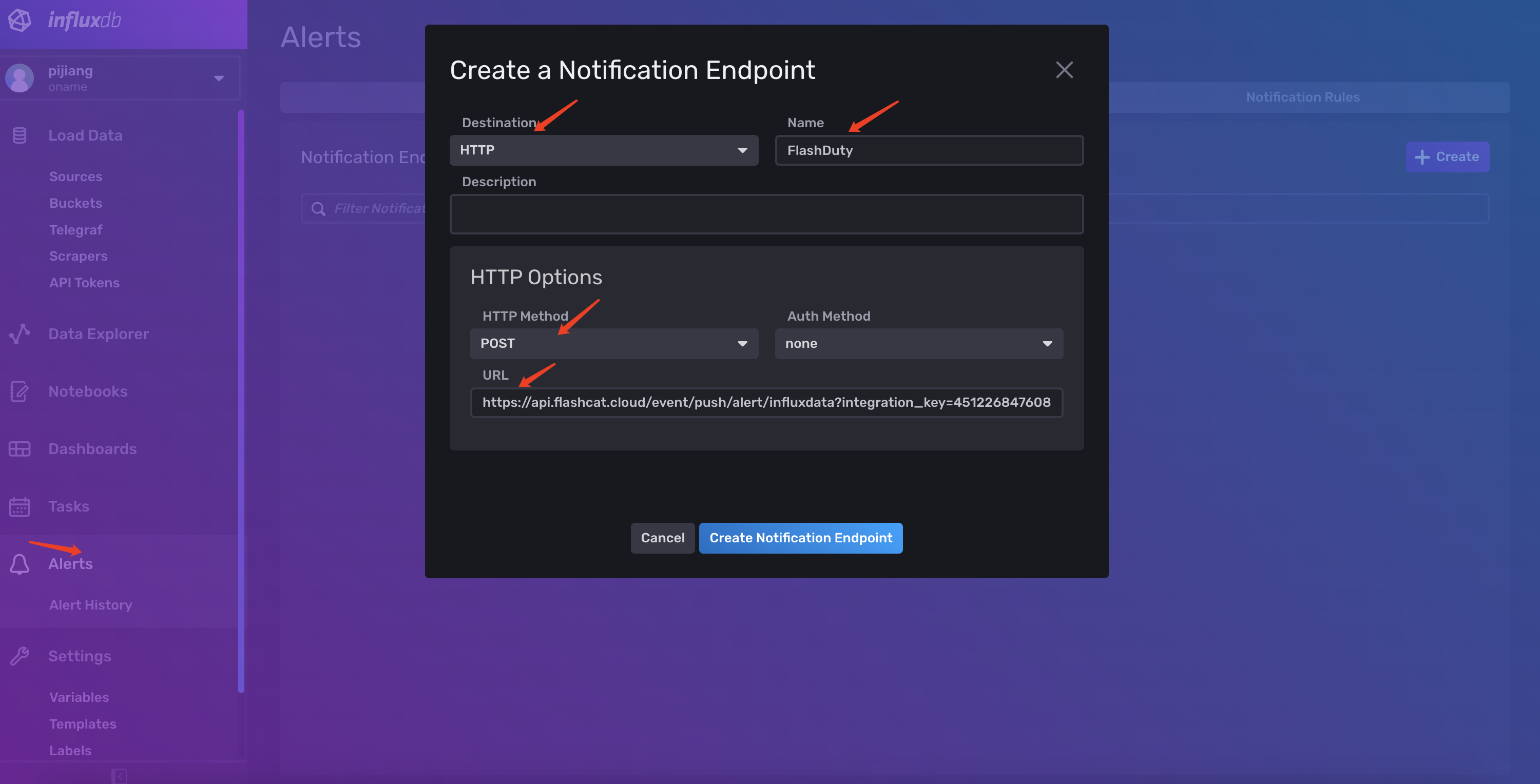
1. Log in to your `Influxdata` console and navigate to the `Alerts > Notification Endpoints` page.
2. Click `Create` to create an alert notification channel.
3. Select `HTTP` for `Destination` and enter `Flashduty` for `Name`.
4. Choose `POST` for `HTTP Method` and enter the integration push URL.
 #### Step 2: Use the Channel Created in Step 1 in Notification Rules
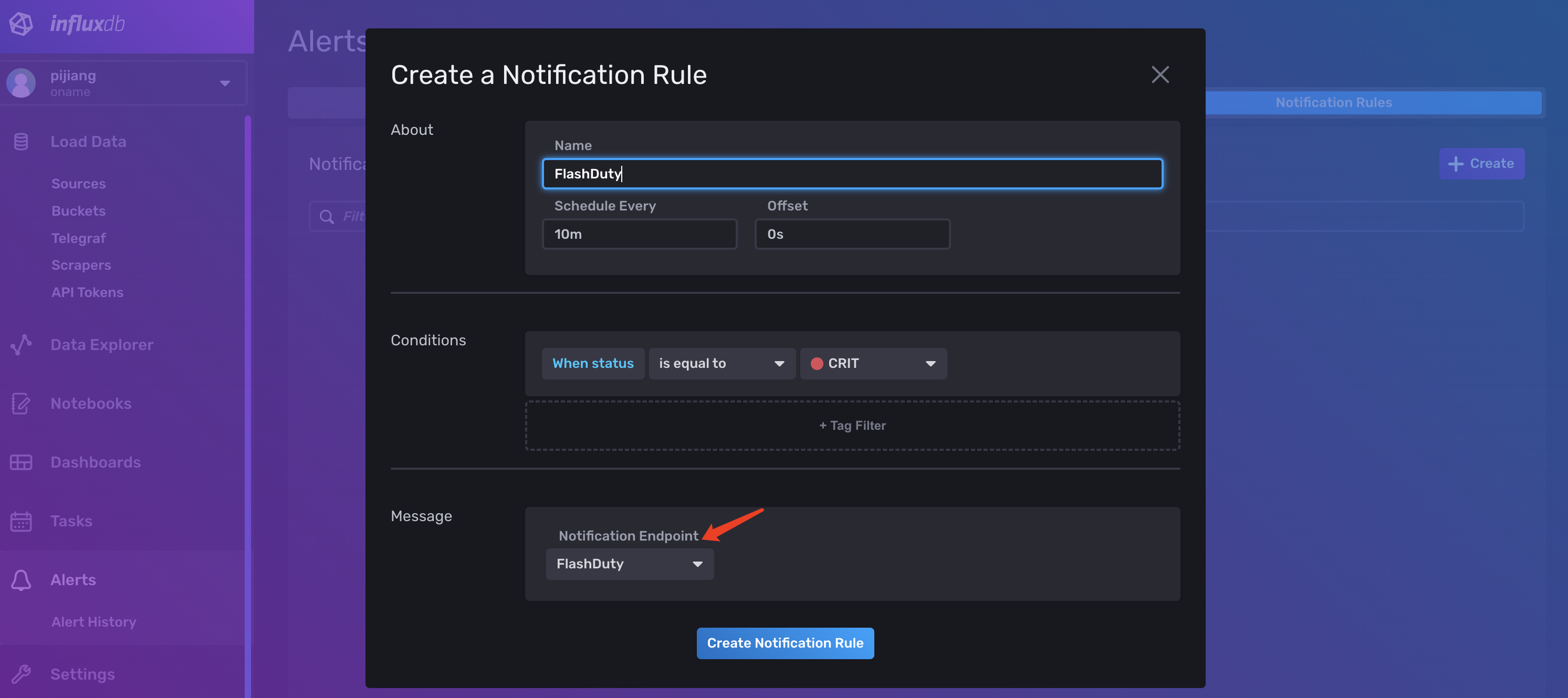
1. Log in to your `Influxdata` console and navigate to the `Alerts > Notification Rules` page.
2. Click `Create` to create an alert notification rule.
3. Configure `About` and `Conditions` as needed.
4. Select `Flashduty` created in Step 1 for `Message`.
#### Step 2: Use the Channel Created in Step 1 in Notification Rules
1. Log in to your `Influxdata` console and navigate to the `Alerts > Notification Rules` page.
2. Click `Create` to create an alert notification rule.
3. Configure `About` and `Conditions` as needed.
4. Select `Flashduty` created in Step 1 for `Message`.
 5. Done.
### Version 1.x
5. Done.
### Version 1.x
1. Log in to your `Influxdata` console and navigate to the `Alerting > Alert Rules` page
2. Click on the alert rule you want to synchronize events for, enter the `Alert Rule Builder` page to start editing the rule
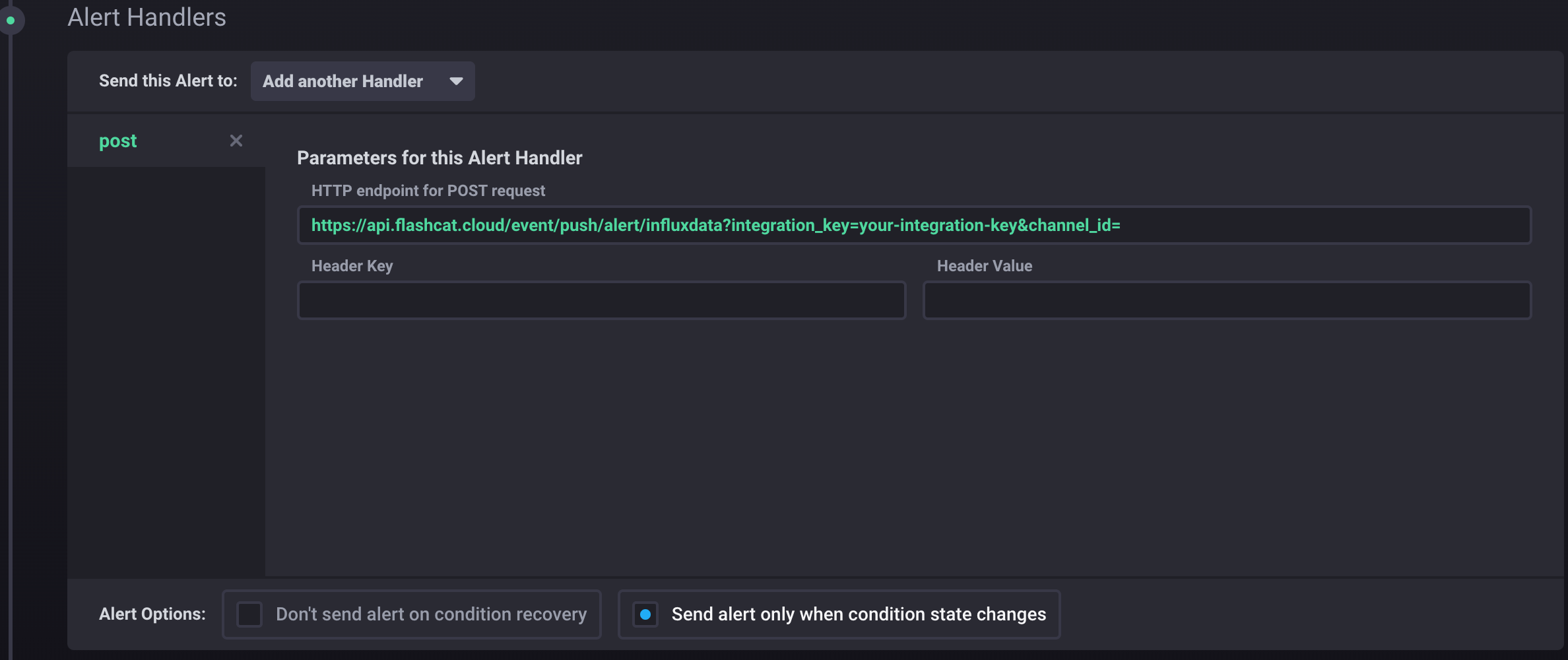
3. In the `Alert Handlers` section, select `Add Another Handler`, choose `post` type, and enter the integration push URL in `HTTP endpoint` as shown below:
4. Click the `Save Rule` button to save. Wait for event triggering. If the latest event time is displayed in the integration list, the configuration is successful and events are being received
5. Done
Mapping relationship between Influxdata alert events and Flashduty alert severity:
| Influxdata | Flashduty | Status |
| ---------- | --------- | -------- |
| CRITICAL | Critical | Critical |
| WARNING | Warning | Warning |
| INFO | Info | Info |
| unknow | Info | Info |